My Generation: Pirates Fans Deserve To Share A Playoff Contender

Could Pirates fans sell out, like in Boston? (Laura Padgett/Creative Commons)

They were applauding a strikeout in the 1st inning.

It was mid-August evening in Boston, the kind of hot muggy night mosquitoes dream about. The normal 2008 sellout crowd was packed into Fenway Park like a family road trip in a Camry.

But when the Red Sox fans applauded Jon Lester getting Rangers’ cleanup man Milton Bradley to swing and miss to end the Top of the 1st, I was applauding right along with them in my black-and-yellow Jason Bay jersey.

The best baseball atmosphere I have ever experienced was that game in Boston. With the Red Sox down a pair of games in the AL East but holding on to a wild card spot, the Fenway Faithful were an assembly of 37,876 with a purpose.They were all paying attention to the game, an alien concept to a 14-year-old Pirates fan. They were focused on each pitch; offering a standing ovation to more than just home runs.

Long before the Boston fans celebrated another win by singing along to “Dirty Water,” I was hooked. It was a contact high of sharing winning baseball with thousands of others.

Cause a big sensation

The ballpark is a different place when it is packed. (Jon Dawson/Creative Commons)

That is exactly what I want to see in Pittsburgh this weekend. The noise and focus may not be to the same extent as Fenway in the heart of a pennant race. It is still June, the Pirates are coming off 19 losing seasons instead of a World Series, and the Bucs probably won’t send seven All-Stars to the Midsummer Classic.

But the team is winning. They are two games out of a playoff spot, putting aside how early that kind of standings-watching may be. Pittsburghers are great baseball fans, just waiting to see a team worthy of their passion and applause. I expect some high attendance in cozy PNC Park, as told to me by the employee at the box office. More importantly, I expect to see folks that are there almost solely to cheer on the Pirates to victory (putting aside Boys II Men fans on Saturday). That’s something that hasn’t been seen too often around here.

Believe me, I love walking up to the ballpark, buying a $20 for $10 from a scalper, then sneaking me the one of the many empty seats behind home plate, where the ushers are as apathetic as the businessmen on their Blackberries. But being surrounded by a huge crowd that is locked in to the game at hand is an experience that can not be beat.

The question now is, can the Pirates maintain that atmosphere longer than they did last year? Can they turn people lining up at the box office on a Friday morning in June into fans cheering on a division leader instead of a playoff long-shot?

Trying to find the key / to fifty million fables

James McDonald is becoming a Cy Young candidate before our eyes. (Alan Kotok/Creative Commons)

They have the opportunity. The great pitching is more sustainable than last year’s model, thanks in no small part to offseason additions Erik Bedard and A.J. Burnett racking up high strikeout totals, and James McDonald transforming into a bat-missing All-Star candidate. Even the rotation’s weak link, Kevin Correia, could be swapped out for Brad Lincoln or the efficient Rudy Owens at some point soon. And while the bullpen is due for a regression from their 2.56 ERA, the peripheral stats and an NL-average FIP (3.79) will likely keep the reliable relief coming.

But we all know it’s the offense that needs improvement. Much grumbling has been expressed over the troubling first two months for winter acquisitions Clint Barmes and Casey McGehee. But even if those two rebound and approach career norms, it won’t be enough to light a true fire under an ice-cold Pirates lineup.

No, the offensive turnaround still lies in the potential of one man in particular, and I think you know who I am talking about:

Meet the new boss / same as the old boss
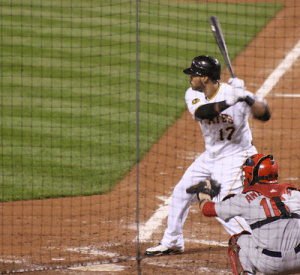
Alvarez is 5th in the Pirates lineup Friday night. (Matt Bandi/Creative Commons)

It has been written time and time again as to become a cliché: the key to the 2012 Pirates season lies in Pedro Alvarez. And yet all clichés have in them a hint of truth. For the Pirates to keep a steady pace with the Reds and Cardinals, they need El Toro to unleash his bullish power.

So far, as center fielder Andrew McCutchen goes, so goes the offensive production. Using Bill James’ “runs created” stat, Andrew McCutchen has created 23.1 percent of the Pirates offense, with Neil Walker (12.9 percent) a distant second. That’s the largest share of any MLB team’s run production this side of Joey Votto (23.4 percent).

That is a testament to Andrew McCutchen’s rising star, but also deeply troubling if McCutchen were to slump or suffer an… well, let’s not even say the “I” word.

We are well aware of what Pedro Alvarez can do. Pirates fans have had visions of him regularly smacking baseballs into the Allegheny River from the time he was chosen out of Vanderbilt with the number two overall pick in 2008. There is no need to rehash the odyssey of Alvarez’s last four years.

Don’t get fooled again?

But we have seen the flashes. Just remember that two-week hitting binge from April 18 to May 4. In 54 plate appearances, he smashed six homers, four doubles, and compiled a .367 average and 1.224 OPS. The strikeouts were there too, but Alvarez didn’t look like he was flailing.

Now for more numbers: The good news is that Pedro Alvarez is swinging at substantially more pitches in the zone this season compared to last year (63.5% in 2011 up to 70%) and making contact with more those pitches (84% up to 85.5%). His line drive rate is down, but he is cutting down on ground balls and infield flies. It’s easy to envision more balls in play dropping for hits moving forward, as his .253 BABIP is far below his .300 career BABIP.

If Alvarez can adjust to the higher number of sliders and curveballs he is seeing this season, he could be in business. With his high strikeout totals, Neal Huntington may never get the star slugger desired. But he might just get an above-average third baseman that is still just 25 years old, and that is an asset.

Then Huntington could stand to add a productive 30-something piece to the lineup like Josh Willingham or Carlos Quentin, giving manager Clint Hurdle the opportunity to put together a lineup that is a legitimate threat to opposing pitchers instead of a Major League laughingstock.

The happy ones are near

PNC Park can be more than just a bastion of losing baseball. (Will Reynolds Young/Creative Commons)

Pittsburghers are longing for a contender, especially those my age that only know a pennant race as something fans of other teams get to feel. They are longing to look at the standings in August and see “PITTSBURGH” at the top. They are longing to watch the Pirates highlights lead off SportsCenter. And most of all, they are longing for a winning team to cheer on like they mean it.

Places like Boston, New York, St. Louis and Philadelphia may take most of the playoff spots and the World Series, but they don’t have a monopoly on loud crowds and excitement at the ballpark. They don’t have to be the only ones who get to applaud their pitcher striking out a guy in the 1st inning.

And now, let’s finish it off with a video cut together by the phenomenal Kurt Gingrich:

Pirates Have Probably Faced The Toughest Starting Pitching In The NL, And It Has Hurt Them

Roy Halladay, Mat Latos and Matt Cain have all held the Pirates scoreless this year. (Photos via Creative Commons)

Opening Day will always be exciting. Spring has sprung, the grass on the field is green once again and you can always count on every seat being filled. Fans wait all winter for the joyous return of baseball.

But there was no joy in Pittsburgh on Opening Day 2012. All-World pitcher Roy Halladay kept the Pirates scoreless for eight innings, and allowed just two baserunners on a cool afternoon. New Phillies closer Jonathan Papelbon wrapped it up, and the Bucs lost their home opener 1-0.

It was a sign of things to come, as the Pirates enter interleague play with baseball’s worst offense. But it was also a precursor to more good starting pitchers faced by the Pittsburgh lineup.

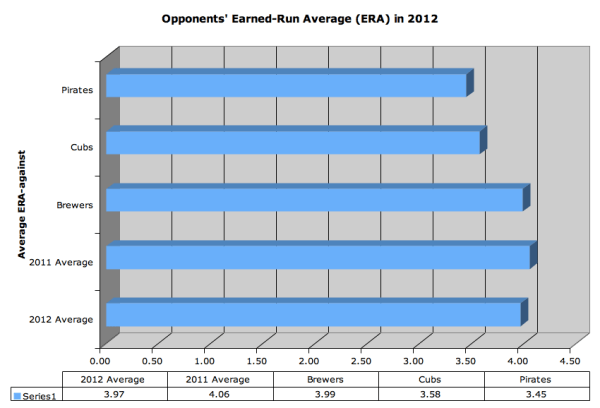
The Pirates have probably faced the toughest starting pitching in the National League through May 17. The earned run average of opponents’ starting pitching has averaged 3.45 this season, compared to the 4.06 average ERA across the NL. If the Pirates faced average starting pitching, they would project to have three more wins this season.

(Note: I took the sample size of ERA since the start of last season, in order to get a number that is more reliable than simply the eight or nine starts that pitchers have made this season. All 2012 ERA numbers have removed starts against the Pirates, since including those numbers would obviously lower the pitcher’s ERA.)

Facing pitchers who average half-a-run better than average has to have deflated the Pirates offense. However, they are still underperforming against those great pitchers. Opposing starters have held Bucco batters to an average of 2.9 earned runs per game, about a half-run lower per game than expected.

I compared the Pirates’ numbers in these areas to two other NL Central teams that have below-average offenses this season: Chicago and Milwaukee. Cubs’ opponents have averaged a 3.58 ERA, while Brewers’ opponents have averaged a 3.99 ERA (with starts against those respective teams removed, as well). So the Pirates have faced tougher starters than both of those teams, and I feel comfortable saying the Bucs have faced the toughest starting pitching in the NL. Checking all the other teams would take about 14 hours, if you want to try to prove me wrong.

So what does this all mean?

The Pirates offense is worse than it should be, but it’s noticeable that the good opposing pitching has directly affected the team’s offensive output this year.

The Bucs’ run output is about 16% lower than expected, based on the ERA of opponents’ starting pitching. If the Pirates were facing an NL-average starter every night, they would likely be scoring about 3.33 earned runs per game, instead of the 2.9 earned runs per game they have put out this season.

An extra 0.43 earned runs per game translates to an extra 16.3 runs to the current offensive output. The team’s pythagorean record (it’s a projected record based on runs scored and runs allowed) is currently 15-23. With those extra runs against average pitching, that pythagorean record would be bumped up to 18-20.

Part of the Pirates’ struggles (not all) has been the bad luck of facing some of the toughest pitching in the National League. It doesn’t get any easier Friday Night with defending AL Cy Young Award winner Justin Verlander on the bump. But perhaps the Bucco bats will come to life in the dog days of summer, against what could be more hittable opponents.

If you would like to look further into the data, here are the links to the Pirates, Cubs, and Brewers numbers, all should be correct through May 18. Any questions? You can email me at santelli@usc.edu.

(Note: I saw this article from Randy Linville right before I was about to publish this blog post. I disagree with his conclusion, since 1. I removed starts against the Pirates for my ERA numbers, 2. I used a larger sample size of eight months of pitching, rather than two.)

INTERVIEW: Pirates Bloggers On Twitter

It’s just like being there!

For most MLB teams, it would be odd that the most popular blog writers live outside of the team’s home city. But this is Pittsburgh. Steel industry leaving, jobs available elsewhere, Pittsburgh Diaspora and so on.

Five of the most popular Pittsburgh Pirates bloggers don’t even live in Pennsylvania. Pat Lackey of Where Have You Gone, Andy Van Slyke is a grad student in North Carolina. Cory of Three Rivers Burgh Blog lives in Wisconsin. North Side Notch‘s Jim Rosati is in Kentucky. Tim Williams of Pirates Prospects lives in Virginia. So does Brian McElhinny of Raise The Jolly Roger, who studies at the University of Virginia.

How do these diehard fans and bloggers maintain the experience of watching a Pirates game with fellow fans, when any fellow fans are hundreds of miles away? With Twitter, of course. The five writers sport a combined 17,000 Twitter followers (give or take a few folks that might follow all or some of them). That is a lot of fellow fans to interact with. So what do these guys think of interacting with Pirates fans on Twitter? I asked them:

1. What are your overall feelings about Twitter?

 @WHYGAVS: I think my favorite thing about Twitter is that it can be whatever you want it to be; I can use it to have real discussions with both Pirate fans and the people that cover the team, I can use it to take the pulse of what other fans are thinking, I can use it to celebrate or commiserate a win or a loss, and on top of everything it’s hands down the best source of real-time news anywhere.

 @timwilliamsP2: Last year there was an earthquake about 30 miles away from my house in Virginia. I was in Pennsylvania at the time, but I was able to go on Twitter 10 seconds after my wife called me, do a search, and find that it was indeed an earthquake that shook our house. Twitter’s search is the best feature for current event topics, in my opinion. And as far as sports and prospects, it really sheds light on rising prospects. Just look at what the #FreeMattHague hash tag did for Hague’s recognition among Pirates fans.

 @ThreeRiversBlog:  I also love it because it only lets you use 140 characters. I know sometimes I wish I could write one more sentence but it forces you to get your point across quickly. It can be a good and bad thing but for the most part I don’t want to read a three paragraph tweet. If I wanted to do that I would go read the person’s blog or articles.

2. Has Twitter changed the way you watch Pirates games/sporting events?

 @NorthSideNotch: For me, being a Pittsburgh sports fan living in Louisville, KY, I can’t even watch games with friends or family who share that feeling of pulling for the same outcome. But when Twitter came along, you are suddenly involved and sharing thoughts and feelings about everything with hundreds of other people doing the same thing you are doing. Watching games on television are so much more fun because of that.

 @WHYGAVS: It definitely has. During games, keeping a Twitter client running is the internet equivalent of watching the game in a room full of fans. Was that pitch a strike? What is Clint Hurdle thinking? Was that error Barmes’s fault or Barajas’? I immediately have access to as many opinions as I need, which is very different from watching a game in an empty room.

 @ThreeRiversBlog: I think it has for me. When I am watching the game at home I have Tweetdeck open and just love seeing what other people have to say during the game. It might be jokes or what the team should do in a certain situation but there is nothing better than when a big play happens and you look at your timeline and everyone is freaking out about it. It is almost like you are there watching it with other people. When I am at games… and there is a close call it is nice to jump on Twitter to see what people are saying who are watching it on TV and have access to replays.

3. How much does Twitter/Facebook drive traffic to the site?

 @RTJR: Every time I post something, the link goes out to Twitter and Facebook and provides a decent bump in traffic (always depending on how interesting the post is, of course). I’d still run the site without it, but it would certainly be more difficult to promote my work.

 @TimWilliamsP2: For the first two years that the site was running, Twitter and Facebook was huge. Referrals represented over 50% of the traffic to the site, and Twitter was a key source… I’ve got about five times as many followers on Twitter than on Facebook. As for the referrals, Twitter represents 8% of the traffic to the site. Facebook sends 1% of the traffic to the site. Most of it these days is direct traffic. So the site would definitely be my full-time job without that traffic. However, that traffic helped get the site to this point.

 @NorthSideNotch: All of my posts are linked to the Twitter and Facebook accounts for the web site. I would say that about half of the site’s daily traffic comes from clips from the links that are posted through social media sites. As far as maintaining the blog without that additional traffic, I would have to say I probably would still do it. However, the interaction with readers on Twitter and seeing the amount of content people will check out definitely makes it easier to maintain.

4. Tim, has Twitter helped to drive book sales or in finding new writers?

 @TimWilliamsP2: I don’t really track where [book] sales originated. But I’m sure it’s like anything else in that it puts the product in front of more eyes. As for new writers, it has helped find a few contributors to the site, usually in the form of a guest post. A few weeks ago, I saw that someone I followed, who runs another site, saying they would be covering the West Virginia game today. I got in touch with them, and they’ll be contributing an article to the site. I wouldn’t have known about this person if it wasn’t for Twitter. When I was hiring a beat writer, one of the key requirements was that the person had Twitter and is very active on the service.

5. How do you think the Pirates organization can use Twitter better? Or do they already use it well?

 @ThreeRiversBlog: I think they could probably use it more to interact with fans. They are getting better at using it but I think it would be awesome if they used it for short interviews with players where they would take questions from fans. It’s all about give and take and trying different things. There is so much you can do with Twitter that all you have to do is ask a question and you will get thousands of responses, especially if you have as many followers as a professional team like the Pirates does.

 @RTJR: I think they do a pretty decent job. I think MLB has some restrictions on stuff that official team accounts can post, but I don’t know exactly what those are. It is kind of alarming how few followers they have (47,000, not that much more than PNC Park’s capacity). My suggestions would be to try and reply and connect with fans more (see @Mariners) and create some sub-accounts to tweet specifically about things like tickets, in game promotions and entertainment, news/lineups, etc.

 @WHYGAVS:  I don’t really mind how the club uses it now, to be honest, which is to break news and keep fans updated about things happening at the ballpark… That said, I do think that teams like the Reds and Astros have done a good job putting their social media people forward on Twitter (Jamie Ramsay and Alyson Footer, respectively), to kind of give a face to the team beyond a faceless automaton. Given how tight-fisted this club is with the flow of information, I doubt we’ll ever see that happen.

 @NorthSideNotch: I guess the one thing I would say they could improve on would be to use it as an advertisement more often, like having a free commercial spot. Perhaps it could be just sending out links to the ticketing site, posting promotional videos, running more specials on tickets, etc. The Pirates are a business, and like any business, they need customers. One of the best things about Twitter is that it allows you to reach a very broad customer base and it does not cost a penny. That needs to be taken advantage of.

—————————————-

Thanks to these guys for taking the time to email with me. Suffice to say, any Pirates fan on Twitter should consider them essential follows.