Why the ALS Ice Bucket Challenge is Actually Good

Quick blog post today. Let’s blame it on my continued recovery from taking the ALS Ice Bucket Challenge at the behest of my brother Andrew. What a jerk.

Here was the result:

It’s time to beat ALS. If I can do a small part by dumping chilly water over my head and chipping in a few dollars to the ALS Association, I’ll do it.

The goals of the challenge are two-fold: raise awareness (Check. Do you really know anyone right now who hasn’t heard of the challenge?) and raise money for ALS care and research (check times $31.5 million).

Opportunists, aka Lame-O’s, are criticizing the challenge and the movement. Let’s not help them further by linking to them, but you know who I am talking about. Thankfully, their petty complaints have been drowned out by good will, kindness and generosity. Are some of the participants slacktivists? Sure. But ultimately, this is all a good thing.

My hope is that the Ice Bucket Challenge, which has been championed largely by us pesky Millennials, starts something of a revolution in charitable giving. I particularly like one of the themes of the challenge: public shaming (in a good-humored social media way) of those who do not answer the call. You get 24 hours: donate or ice yourself, or better yet, do both. We’re all doing this together.

The possibility seems to be that if we band together, we can cure a disease. And we should continue to think this way. Our generation can move mountains and fix the ills of the often-diseased Earth we’ve inherited. But we need to work together.

I encourage you to watch this TED Talk from Dan Pallotta (as douchey as that sentence sounds). Many people see charities the wrong way, wanting them to be efficient in getting their donations directly to the cause and to not “waste” money on overhead.

Pallotta says we are dead wrong with this attitude. One point he makes deserves to be quoted in full:

“We’ve all been taught that charities should spend as little as possible on overhead things like fundraising under the theory that, well, the less money you spend on fundraising, the more money there is available for the cause. Well, that’s true if it’s a depressing world in which this pie cannot be made any bigger. But if it’s a logical world in which investment in fundraising actually raises more funds and makes the pie bigger, then we have it precisely backwards, and we should be investing more money, not less, in fundraising, because fundraising is the one thing that has the potential to multiply the amount of money available for the cause that we care about so deeply.”

(Emphasis added.)

Our generation can be one of change in charity with the goal of accomplishing huge feats like curing diseases, ending hunger in the United States and eliminating malaria. I encourage you to create a list of the big charities out there doing great work. Even if you, like me, don’t make a lot of money, create the list anyway. Then, whatever you can give, do it. Have your favored charities and support them. Encourage friends to do the same. Come up with your own challenge. I’ll do the same.

Let’s disrupt the charity.

New Study Shows Tuesday Night to be Sexiest Night of the Week

Nightclub Photo

Sayonara, Saturday. Farewell, Friday. Think again, Thursday. The sexiest night of the week is Tuesday, according to scientists at the Stanford University Institute for Debauchery Research.

The new study contradicts conventional wisdom that weekend evenings provide peak sex appeal and opportunities for general hot-bloodedness. But researchers analyzed the habits and feelings of 1,372 young adults each day of the week and found that Tuesday night offers the optimal environment for getting down.

“There’s a stereotype, one that’s very difficult to break, that Friday and Saturday evenings are the hotness,” said Dr. Robert Seager, a Stanford professor who first had the idea for the study. “I wanted to start from scratch, with no preconceptions, and use new formulas to measure the hedonism of each day.

Music icons of the early 1970s created the now-longstanding idea that Saturday was the sexiest of the seven days, said Seager, raising the profile of the week’s final day with such hit songs as Chicago’s “Saturday in the Park” and Elton John’s “Saturday Night’s Alright (For Fighting).”

Seager notes that Saturday night may have in fact been “peak sexy” during the 1970s and the 1980s, but he believes his institute’s study confirms that today’s young people should find Tuesday to be even steamier than the weekend.

“If people had listened to me — to my research — back in the day, I always had suspicions that the early part of the week had its merits,” Seager said. “You’re looking for ladies who have all of the skills? Are you young? Restless? Bored? Head out on a Tuesday.”

The Institute for Debauchery Research (IDR) studied subjects between the ages of 20 to 29 (“the sexiest decade,” Seager notes). The study emphasized quantitative aspects of sexiness, including hemline index, abdominal saturation, grenade avoidance, makeup retention and subjects evaluating members of the opposite sex on the “traditional” 1-to-10 scale.

IDR’s conclusion that Tuesday night represented the height of eroticism was surprising to many of the researchers, including D. Michael Carter, a graduate fellow on the project.

“I just always thought the weekends were the sexiest segment of the week,” Carter said. “But when you analyze the data set, it proves that Tuesday has the greatest concentration of bodies that got that A1 credit — that filet mignon, if you will.”

Carter reiterated that the institute was not interested in finding the day most people frequent bars and clubs, but rather the day that featured the highest average of appealing individuals.

“Sure, you’ll always find hotties on Fridays and Saturdays. We’re not reinventing the wheel,” Carter said. “We just want people to know that if you go out on a Tuesday, you will generally find a higher percentage of lovely lady lump and shawties who tend to wanna hump.

“The science just proves it.”

Want to Give a Team Stat More Punch? Rank It

Stats

I don’t mean to pick on people, but I do need a recent example of kinda-useless-stat deployment.

So, Gene Collier. You’re a very good writer and you’ve always been kind to me. Your writing is funny, and as anyone who reads my work can attest, it is very difficult to be funny in print.

I’m afraid you must be a mark in this case.

This stat received wide exposure in being tweeted to Collier’s 8,600 followers and retweeted to the Pittsburgh Post-Gazette‘s 54,000-plus followers.

At first, this seems like a statistic of note. Look how big a difference striking first (or being struck against first) can make! Over a full season, it’s the difference between the Pirates being a 112-win team and being a 57-win team, between being an all-time great and being hide-the-children horrible.

Pittsburgh Pirates bad

The Pirates lose a lot when they trail. So what? (RJ Schmidt/Creative Commons)

However you must realize — of course this is the case! This is not something unique to the Pirates. If MLB mandated that every Pirates opponent start the game up 1-0 with a runner on base (this would be the scenario for most non-homer opening leads), the Bucs would only expect to win 36 percent of their games. So naturally, they’re bad when they fall behind in a contest.

Now, I may give Collier some benefit of the doubt. Perhaps he was only trying to illustrate this point — in baseball, if you fall behind, you lose very often.

I have seen these kinds of stats too many times, though. You know the ones: the Mudville 9 lose a lot when they trail after seven innings, the Charlestown Chiefs win a lot when Reggie Dunlop scores a goal. The Pittsburgh Pisces lose a lot when they get out-rebounded. You get the idea.

Give a Ranking

Nothing is particularly wrong with these kinds of stats. They’re interesting trivia. It may make a viewer say “Oh wow. The Globetrotters are 340-0 when they convert five straight dunks. That’s impressive.” Not a bad thing.

However, we can do better. It is very easy to give your team-based stat more impact by adding a simple piece: including a league-wide ranking. Here are some real numbers that carry a little more ‘oomph’ when they have a ranking (all true as of the beginning of Monday):

  • The Seattle Mariners are 39-28 against teams above .500 this season… the best mark in the Majors.
  • The Washington Redskins’ average starting field position is at their own 25-yard line… the worst mark in the NFL.
  • The Colorado Avalanche are 28-4-8 in one-goal games, best in the NHL.
  • The Miami Heat are converting 56 percent of their two-point field goals, by far the best mark in the league.

For most of these odd team-based stats, the average fan may not know if the number is really that good. Yes, we know a .400 batting average, four-goal game and out-rebounding your opponent are all positives.

But some stats can be confusing without a little added context. And the easiest context to give these kinds of stats is a 1-to-30 (or 1-to-32 in the NFL) ranking of where the team stands in that area. If you or the team communications manager took enough time to research this frivolous little number, the least you can do is do two minutes more work and better serve the fan.

Personally, a total of 99.4 percent of my readers love this blog, best in all of WordPress.

Five Confusing, Misused Words and Phrases

Dictionary

This is the first of an occasional series, likely when I don’t have any better ideas. Let’s discuss the English words and phrases that are confusing by their nature or have become twisted by American speakers into a different “common” meaning. I love words; I just hate that people use them.

“Could Care Less”

This one came from a phrase with worthwhile intentions. There are many, many things about which I don’t care. I could use a phrase to emphasize the fact that my CARE LEVEL is zero. In comes “couldn’t care less.” Perfect. The phrase recognizes that my amount of caring is of the lowest possible degree. It cannot be lessened.

So what a shame that I can’t enjoy the phrase because so many people get it wrong. They say “I could care less” or other variants. Curses. I get that you can get tripped up by the double negative, but the implication becomes that you care at least somewhat. And caring is stupid.

“Subpar” and “Below Par”

“Hey, pal! How’d you hit ’em on the golf course today?”
My round ended up being subpar.
“Terrific!”

What a pair of conflicting definitions when you remember that being below par in golf is good/the goal.

1. (golf) (of a score) Less than par for the hole or course
2. (idiomatic) Not up to the average or normal standard

 That doesn’t mean that people are misusing the word, really. I just wonder how definition No. 2 came about.

“Payoff Pitch”

Another sports term that makes sense at first, but break it down. Announcers use it for any ol’ 3-2 pitch. It implies that the next pitch will lead to the end of the at-bat by either a strikeout, walk or ball in play. Often it does. Just as often it does not.

That’s unfortunate. The term “payoff pitch” sounds nice. It’s less jargon-y than other baseball terms like “blown save,” “platoon player,” “hot stove” and why in the world a pop-up to the outfield can trigger the infield fly rule. Anyone could understand a pitch having a payoff, but it doesn’t work as such.”

“Notoriety”

The correct definition is “the state of being famous or well known for some bad quality or deed.” Emphasize bad. It describes someone of ill repute. The adjective form is “notorious,” and that usually gets used correctly.

Somehow “notoriety” just became a synonym for “famous.” We may need other synonyms for famous, especially in a world where media have become so fragmented that one person’s famous is another’s unknown. What percentage of America do you think actually know who Mike Trout is? But notoriety is not the word. It needs to keep its definition of “famous for bad things,” because that description can apply to many more people than just B.I.G.

“All Downhill From Here”

I’m certain people used this correctly at first. Going downhill is easy and fun! Think of all the exciting activities that involve a downward trajectory on a hill: skiing, snowboarding, sledding, skateboarding, snowtubing, water slides and good ol’-fashioned rolling down the grass.

Yet the phrase “all downhill from here” has often come to mean an experience is only going to be bad (then worse) in the future. Some may even describe such an experience as “an uphill battle.” If we reclaim “all downhill” to mean being easy and fun, we can eliminate this contradiction that calls Sisyphus to mind. This is the hill I’ll die on.

Have suggestions for a future edition of Confusing/Misused? Let me know in the comments. And because I am taking a position as shaming poor grammar, go right ahead and criticize my word mistakes as well. I deserve it.

Ballpark Review: Nationals Park

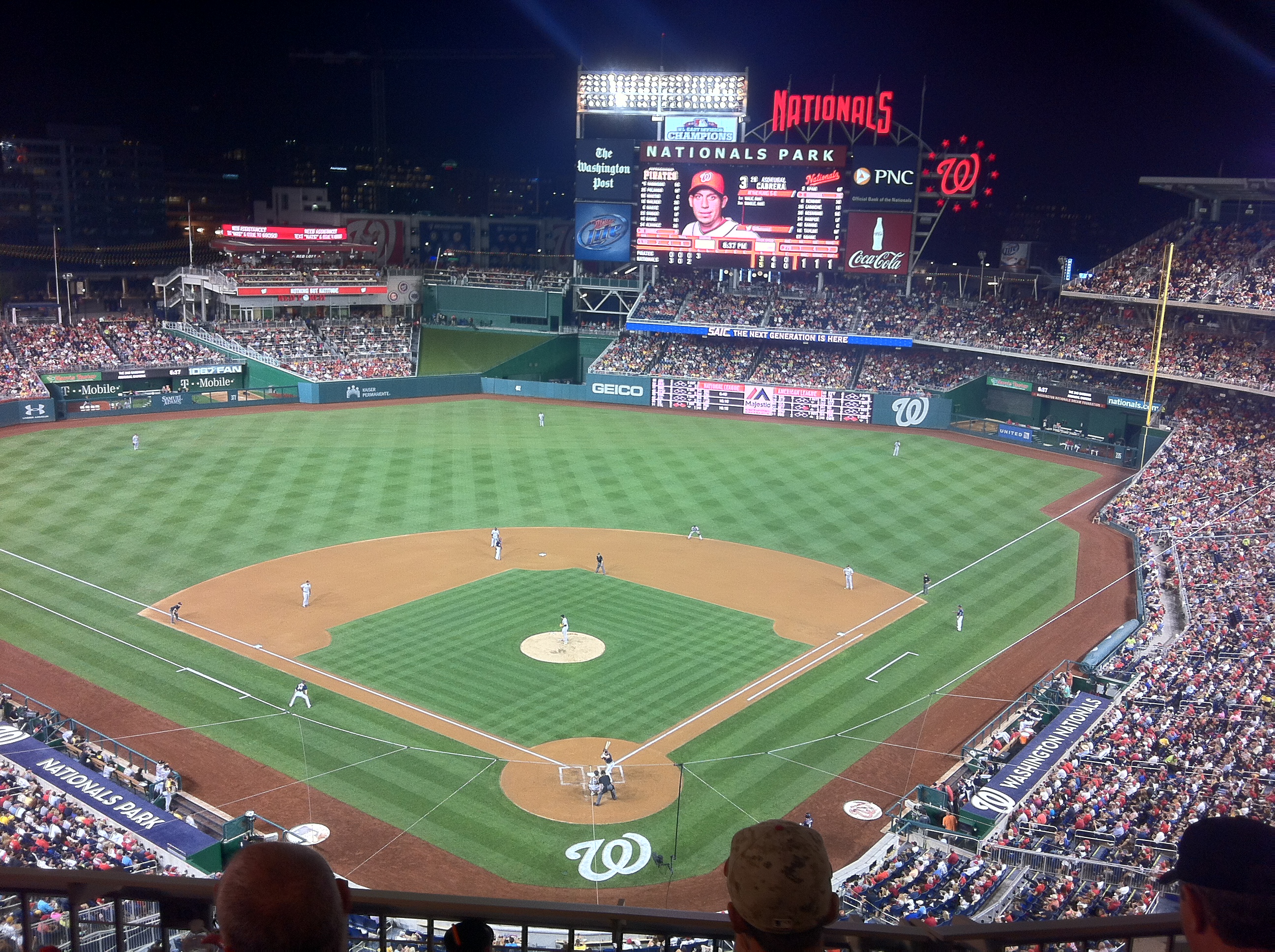
Nationals Park

As my father and I entered Nationals Park, we were handed a promotional Nationals hat, one of those cheap little ballcaps with the Miller Lite logo emblazoned on the back. I was a bit put off by the fact that the team had a promo item it could give only to people 21 and over. You really can’t get another sponsor that is not a beer maker? But hey, free hat. And it had a bottle opener! Classy.

We said were probably never going to wear the caps, especially during a Nats-Pirates game. They would most likely end up as donations to St. Vincent de Paul (we’re such good Catholic boys) instead of growing a healthy layer of dust. Then as we stood in a concession line before the game, a man walked up to me, noticed my Pirates shirt and hat, and asked, “Are you really going to take a Nationals hat back with you?”

“I guess so,” I responded.

“Would you be interested in selling it?” he asked.

“How much?”

“Twenty dollars.”

My dad held out his hat and interjected: “You want to buy two?”

We would have taken five dollars each. I’m not sure why this entrepreneur couldn’t wait until the end of the game and scavenge the hats that people would inevitably forget below their seats. But I wasn’t going to argue with the man. My dad and I were in the ballpark all of 10 minutes, and we had already make $40. I only wish they had blackjack at Nationals Park so I could keep my luck going.

A Park to be Proud Of

Nationals Park night

Neither good nor bad, but I noticed the lights at Nationals Park were much whiter and brighter and any other MLB park I have attended.

The point of that story (besides it being awesome) is that our personal experiences will inevitably color how we feel about the places we visit. Visiting Rome is the delight of a lifetime, a place soaked in history. But if you went once and got pick-pocketed or had to sit through two rainy days, you won’t remember Rome with the same joy as a regular visitor.

Let that fact act as a disclaimer for all my travel reviews and eventual ballpark rankings. If I am lucky, I get to spend a few days in a city or a three-game series in a park. Mostly, though, it’s one day or one game. My impressions of a place will naturally be colored personal experience or the conditions on a certain day. I went to DC on a beautiful, mild day, in a great mood and surrounded by Pirates fans. All before a guy gave me 20 bucks.

All that being said, I really liked Nationals Park. It has a modern look: steel, concrete and glass are the motif as it mimics DC’s monuments. A red-brick park would look out of place. Concourses are wide. Concessions are plentiful. Views of the field are splendid all over. A guy gave me 20 bucks.

The ballpark experience was sandwiched by a pre- and post-game jaunt to The Half Street Fairgrounds, just beyond the center field gate. The party noise is unmistakable as you exit the Navy Yard Metro station and pass by the fairgrounds. Step inside. On one side, a live band plays cover music and entertains. On another side, rows of beer stands ensure you don’t head in the park thirsty. On another, teams of amateur cornholers “toss their sacks around,” as the kids say. With temperatures mercifully in the low 80’s, sitting in the sun with a pre-game beer could not have been more pleasant.

The one real negative: this is a ballpark that could very easily have a terrific view. If it pointed directly north, unobstructed, it could feature a backdrop of the U.S. Capitol building and other DC buildings. Instead, the team built (to be fair, necessary) parking garages that dominate views from the lower decks of seats. The sections and decks in the park are fragmented as well, and the upper deck is pushed too high by the luxury suites and club level. It results in a park that feels much bigger and broken up than a 42,000-seater should.

However, if you’re living in a mid-Atlantic state and have not attended the six-year-old ballpark, it is well worth it. My dad and I combined an afternoon of sightseeing at the National Air and Space Museum (awesome) and National Museum of the American Indian (beautiful but meh) with an evening game. I can’t think of many better ways to spend a day.

Some Newbie Tips

Half Street Fairgrounds The Bullpen

The Half Street Fairgrounds attract a large crowd on Friday nights.

Do plan to arrive early and stay after if you are taking the Metro. Nationals Park scores huge points with me by being located less than a block from a subway stop. DC’s Metro is clean and reliable; I even saw one Pirates player taking it after Friday’s game. However, the trains can get crowded just before and after Nats games. Stop and hang around the aforementioned Half Street Fairgrounds for a post-game drink (shout-out to @ndbrian for the invite). Take heed: if you are leaving a Sunday-to-Thursday game, get on the train by 11:20 p.m. so you can make your return trip before the system shuts down.

Don’t be afraid to wear your team colors proudly. Nationals fans must be accustomed to seeing visiting fans infiltrate their ballpark. The DC area has a lot of transplants, and out-of-towners from Pittsburgh, New York, Philadelphia and Baltimore can make a quick pilgrimage for games. Our section enjoyed many loud (though not obnoxious) Pirates fans, and the home supporters did not really hassle us.

Do consider buying the Beltway Burger Pack if you go on a Thursday or Friday. For $29 or $33 (based on if the Nationals call it a “prime game”), you get an outfield ticket along with a burger, fries and soft drink. Normally, the ticket is $26 and the collection of food is $19. I like to seek out unique food options at a ballpark, but I couldn’t resist this value. Be warned, though, if your seat with the package is in right field…

Don’t sit in sections 138 to 143 if you want to see the scoreboard. In any ballpark, there are seats that force you to crane your neck around to see the video board. But Nationals Park has two decks of seating in right field below their board; if you sit in the lower deck, you are simply blocked entirely from seeing it. I am fine not having a video board to watch (Wrigley lacks one, and people don’t seem to mind), but Nationals Park’s is high-definition and stunning. My dad called it the best he has ever seen.

You will really enjoy a trip to Nationals Park, especially as buildings continue to spring up in the Navy Yard area and create more things to do before and after the game.

In conclusion, a guy bought a crappy Nationals cap from me for 20 bucks.

What Makes a Good Major League Ballpark?

Dodger Stadium Evening

If you’re expecting the type of researched pieces of import that you’ve seen the last few days (well, researched enough for a blog), you best turn around now. I’m writing as I travel on Interstate 70 heading to Washington, D.C. for the Friday night Pirates-Nationals game.

Don’t worry, my dad is driving. I have not yet mastered the ability to type on a laptop and drive on the interstate at the same time. Surface streets? Sure. Not the interstate.

Nationals Park will be Major League Ballpark number 15 that I have visited. So in terms of visiting every park, I’m halfway there/living on a prayer. At some point I will craft a ranking of the 15 stadiums that are unfortunate enough to have had me as a guest, along with tips for fans looking to visit, but that will be another day when I have steady Internet access.

There are elements of a good ballpark to my eyes. It should (among other elements) feel intimate without needing to know if the guy two rows down put on deodorant this morning, have quality food options that reflect the area, feel connected to the neighborhood around it, support an exciting atmosphere in the crowd, and if possible, have a nice view.

Citizens Bank ParkI won’t give away too much of what I like and dislike from the park’s I have visited. That would ruin the forthcoming rankings! But I will say that being unique scores points with me. Citizens Bank Park is well-constructed, has ample room in the concourse, tasty food and fosters a fun atmosphere for baseball. But the red-brick-and-steel design and placement in the middle of a parking lot that should have its own zip code restrict any feelings of originality or connection to Philadelphia as a city. I’m sure it’s an improvement on Veterans Stadium, but it won’t be in my top class.

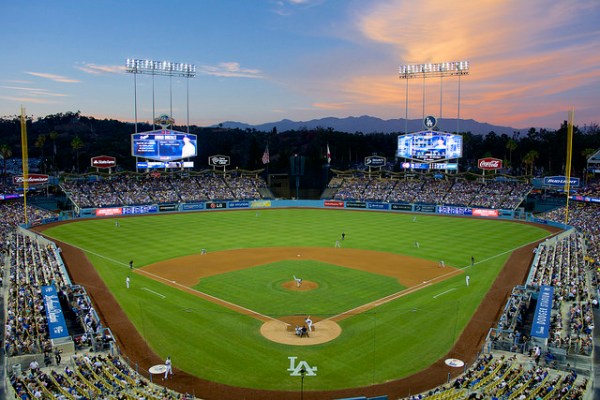
I don’t much care about a stadium’s capacity being too big or too small, but it needs to be well-designed to its capacity. Dodger Stadium represents a brilliant way to hold 56,000 fans. Three decks plus a smaller “top deck” that doesn’t extend too far around, plus outfield sections that don’t extend too high. Chase Field feels more cavernous, even though it has fewer seats. Good design can mask a park being “too big.”

Finally, it helps to be nice. One of the reasons families return to Disney parks and resorts year after year is the company’s devotion to customer service. People visiting the park are not “customers,” they are “guests,” and they are treated as such. Some teams should take this to heart. The ushers have to maintain order and the cashiers are probably making minimum wage, but you are in the guest service business. There is no reason that you can’t treat your fans as well as Disney treats its guests. Trust me, it pays off.

All right, well it is time to do a little D.C. sightseeing before I get a taste of Nationals Park. Maybe it will find its way toward the top of the list.

Effectively Wild, Pocket, Jonah Keri: “Things I Like” Thursday

Oprah had her favorite things. Mine are objectively better.

The meaning of “Like” has been unfortunately co-opted by Facebook and Instagram. Now we like everything, including a high school acquaintance writing that her grandpa passed away. We must re-capture “Like.”

So every other Thursday, I will recommend three things that I like and think you should check out as well. I’ll steer clear of recommendations like, “Hey, have you heard about this Guardians of the Galaxy movie?” or “I’ve been trying out this service called Uber…” Both make more money than Satan’s rich father (a noted Wall Street executive), so they don’t need my help.

The goal is (A) to refer you to media items of quality, which is always a good idea, and (B) encourage an environment in which more people advocate for what they enjoy. The recent layoffs of writers from The Score and Sports on Earth remind me that just because something is well-done doesn’t mean it is garnering an audience. Let’s spend a little less time railing about what we hate and a little more time sharing what we love. It’s the only way a meritocracy will work.

On to the things I like, Part 1!

Effectively Wild: The Daily Baseball Prospectus Podcast (LINK)

Effectively Wild PodcastGod bless the no-doubt-sleep-deprived hosts of Effectively Wild, Ben Lindbergh and Sam Miller. They not only turn out 35-minute podcasts (give or take) every weekday, they both produce some of the best baseball writing on the web and run a stellar website at Baseball Prospectus (Lindbergh is the former editor-in-chief, Miller is the current one).

Problem is, much of Miller’s great content is behind the BP paywall. The site’s pieces are well worth the $40 per year subscription, but I understand if you can’t put the money together for it. Lindbergh is now at Grantland full-time (though he stole $800 from me), so all his stuff is free. And I’m thankful the podcast is continuing after his departure from the site.

As a daily podcast, Effectively Wild functions as a discussion of the headline stories and trends in baseball that smart fans should care about. The two come at the stories from a mostly analytical perspective, but they are also journalists who know a lot about MLB’s inner workings. I learn new things about the game every time I listen. Their recent podcast on “How to Hire a GM” was particularly insightful.

Listening to the show is like having two dry, intelligent friends who have great baseball discussions every day. Check out the RSS feed or iTunes listing, and I’m sure you will find a topic that piques your interest.

Pocket (LINK)

Pocket App LogoIf you’re like me, change your life and habits immediately you spend a lot of time on Twitter. I follow many great writers, one of whom is mentioned in the following section, and I need a way to organize all of the pieces of theirs I want to read.

Enter Pocket. There are several good article-bookmarking apps out there; maybe you’ve heard of Instapaper. But I like Pocket best, plus it is free. There are apps for iOS and Android devices, Chrome and Mac plus GetPocket.com. LifeHacker has detailed the features further.

Mostly, I save links using Tweetbot (Pocket service is integrated to the app) and the Chrome extension, Then I use the iPhone app or website to read the stories that I have bookmarked. My reading list is always packed with content, and I feel as though I am reading more quality pieces than ever before.

The killer feature: offline saving, to read articles on airplanes and subway trains. Beautiful.

Jonah Keri (LINK)

Jonah Keri Extra 2%My only problem with using Pocket is that I have hundreds of saved articles, many probably fantastic, that I will just never get to reading. There are too many good writers and too much good writing out there that even I, an unemployed insomniac, can’t consume it all.

Still, I try to make time for pieces from a few choice writers. One of these is Jonah Keri. If you’re unfamiliar, Keri writes standout baseball stories for Grantland, including the unmatched series The 30 examining particularly interesting aspects of a few MLB teams each week. His background as a financial journalist shows in his firm grasp of baseball numbers and analytics, but his writing style teems with a love for the game and sharp Canadian sense of humor.

Keri also authored the indispensable Baseball Between the Numbers as well as The Extra 2% about the Tampa Bay Rays. The latter is my favorite baseball book of the last five years, a must-read for newbies wondering how all these fancy baseball stats can possibly lead to winning ballgames. Up next, his new Montreal Expos book Up, Up, and Away (along with your kiss) is on my list.

If you can’t commit to reading one of his books, I recommend his Grand Theft Baseball piece, an award-winner for good reason. Keri is the baseball writer I want to be.