Top 15 Pittsburgh Pirates Prospects for 2013 – A Compilation

Gerrit Cole
Gerrit Cole

Gerrit Cole was ranked as the Pirates’ top prospect on all six lists.

With regard to sample sizes, if some is good, more is better. I compiled the Top 10 rankings of prospects in the Pittsburgh Pirates farm system from Baseball America, ESPN’s Keith Law and Baseball Prospectus’ Jason Parks, along with the Top 20 rankings from Pirates Prospects, MLB.com’s Jonathan Mayo and SB Nation’s John Sickels.

Outside of the top seven prospects, who all appeared in the Top 10 of every list, players can have wildly different spots in individual rankings. Kyle McPherson was rated everywhere from 7th (Baseball America, Mayo) to 13th (Sickels). Tyler Glasnow was slotted as high as 8th (Pirates Prospects, Baseball Prospectus) and as low as 19th (Mayo). Wyatt Mathisen fluctuated from 7th (Baseball Prospectus) to 16th (Pirates Prospects).

None of these individual lists are necessarily wrong, and I certainly do not wish to denigrate the hard work all of these outlets/writers do to evaluate prospects. Quite the opposite, as these are the six outlets I respect most for their analysis of minor league systems. The rankings just reflect the wisdom of multiple experts to try to gather the strongest list possible.

1. RHP Gerrit Cole
2. RHP Jameson Taillon
3. OF Gregory Polanco
4. SS Alen Hanson
5. RHP Luis Heredia
6. OF Josh Bell
7. OF Barrett Barnes

8. RHP Nick Kingham
9. RHP Kyle McPherson
10. C Wyatt Mathisen
11. RHP Clay Holmes
12. RHP Tyler Glasnow
13. LHP Justin Wilson
14. 2B Dilson Herrera
15. RHP Bryan Morris

Just missed: C Tony Sanchez, RHP Vic Black, 1B Alex Dickerson, LHP Andrew Oliver

Real Progress: How to better evaluate Neal Huntington’s record as Pirates GM

Pedro Alvarez

Pedro Alvarez, a 30-home-run hitter drafted by Neal Huntington. (Keith Allison/Creative Commons)

Columnists come up with fun generalizations on occasion.

The won-loss record is the only way to judge any general manager.

– Ron Cook, noted baseball scholar. September 28, 2012

That’s right, Ron Cook. It’s the only way to judge a general manager if you don’t factor in payroll, market size, revenue, meddling owners, injuries, expiring contracts, bad managers you didn’t hire, strength of schedule or any number of other factors over which a Major League GM has little to no control.

Over the last few days, it has become fashionable to quote the Pittsburgh Pirates’ won-loss records under the last three general managers as a way of “proving” the Pirates have made no progress under Neal Huntington. I have even see writers I respect like Alan Robinson and Dejan Kovacevic repeat the records.

Doing so completely disregards the state of the Pirates franchise when Neal Huntington took the job on Sept. 25, 2007, as well as the strategy he took to fix it. Huntington had no control over how the team was built before he became GM, and yet some people want to categorize the sins of the past under his name (with regards to the 2008-10 Pirates teams).

While previous GM Dave Littlefield didn’t tear up the soil and salt the earth in his final years as general manager, he did leave the new management in a peculiar situation. The Major League club was passable, but not a contender, and the farm system was in the bottom half of MLB in terms of overall talent.

The first three years of Neal Huntington’s tenure as general manager saw a definitive strategy in mind: trade Major League players whose contracts are set to expire, and replenish the minor league teams with future players from top to bottom. The result of that strategy has produced thousands of words and arguments already, touting the successes (acquiring Jeff Karstens, Joel Hanrahan, James McDonald, etc.) as well as admonishing the failures (Tim Alderson, Andy LaRoche, Lastings Milledge, etc.). Jose Tabata, the jury is still out on you.

My point is not to evaluate whether Huntington’s thrash-and-burn strategy has worked or not. But one simply has to recognize that Huntington and Co. knew the immediate consequences of it: liquidating the Major League roster of players like Freddy Sanchez, Jason Bay, Adam LaRoche and Xavier Nady took a mediocre Major League roster and made it bad. So the Pirates surely wouldn’t win a lot of games from 2008 through 2010, but rather improve the farm system in an attempt to build a true playoff contender beyond those years.

When folks quote the Pirates’ won-loss record under Huntington, they are completely ignoring the one basic truth about his tenure: his goal was not to make the Major League team a winner by 2010. Quite the opposite, actually, as the 2010 team had the youngest offense in all of baseball. Again, I’m not here to draw a conclusion whether Huntington should keep his job. I’m simply stating the facts behind his strategy.

Since those fire sale years, the Major League product has improved. The 2009 and 2010 Pirates teams limped to a .367 winning percentage and a minus-411 run differential. But the 2011 and 2012 teams made the jump to a far more respectable .464 winning percentage and a minus-126 run differential.

Being under .500 and having a negative run differential is not the goal. But the Pirates have undoubtedly shown improvement under Neal Huntington, and there’s more talent on the way.

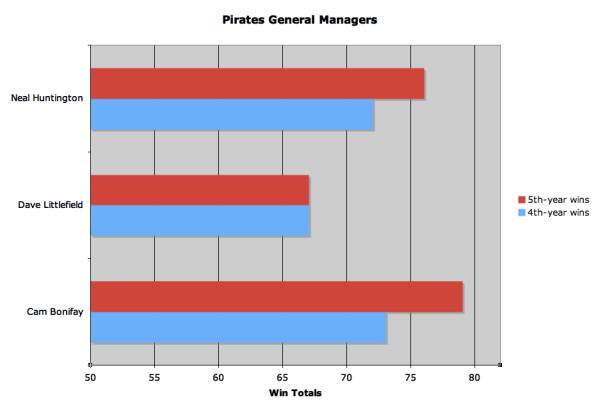
So fine, Ron Cook, et al. If you would like to keep quoting records, I would like to make a suggestion. Quote the won-loss records for the last three Pirates’ general managers in their fourth and fifth full seasons on the job. It is far from perfect, and certainly doesn’t eliminate the variables of which a GM cannot control. However, it draws from the notion that GMs of small-market teams should be evaluated on the performance of the team later in their tenure, not at the very beginning of a rebuilding project.

Charting the Pirates general managers in their 4th and 5th years on the job

Note that Littlefield took over in July 2001, so I took 2002 as his first season. And while Bonifay wasn’t able to improve on that 79-win product in 1997, he got almost four more seasons to do so. Littlefield? His time as GM only saw the transformation of a 62-win team into a 68-win team with little to speak of in the minors.

Huntington has built something from that 68-win team/shallow farm system left behind by Littlefield. It’s now a 77-win team (with possibly a couple more wins to go this season) featuring a far better farm system to create a sustainable product.

Yeah, I just played your game, Ron Cook. I judged the general managers based on win-loss record. And by doing so, Huntington actually looks better than all the anger about the Pirates’ 2012 collapse would have you believe. After all, he has substantially improved the Pirates’ win-loss record each of the last two seasons without shipping out any prospects better than Robbie Grossman or Rudy Owens.

A winning baseball team in Pittsburgh? It’s in progress.

Fastballs and Stress: Five Problems for James McDonald (And Reasons For Optimism)

It has been a lonely few starts on the mound for McDonald. (Jon Dawson/Creative Commons)

How quickly things change when you are in the heart of a pennant race.

Six starts ago, Pirates pitcher James McDonald was putting up some of the best numbers in baseball — 3rd in the National League in both ERA and baserunners per inning. Six starts ago, Buccos fans were steamed that McDonald was not on the All-Star team, and talking about him as a Cy Young dark horse (myself included). Six starts ago, McDonald was seen as a pitcher that would lead Pittsburgh’s charge to the first postseason in a generation.

In reality, six starts is not a whole lot of time to evaluate a pitcher. One time through a tough lineup can sway the numbers a lot, a few bloop hits could drop in or a pitcher could just come out flat on a given night.

Yet one can not deny that fans are seeing a vastly different James McDonald than they saw a month ago.

It is a pennant race, and patience is at a premium. As the Pirates sit right on the Wild Card bubble heading into Thursday, and it is possible that McDonald could be relegated to the bullpen.

That decision is up to Clint Hurdle. But I wanted to look at what has changed for “J-Mac” over those six starts since the All-Star Break (or ASB). Props go out to Brooks Baseball and FanGraphs for the raw data; I could not have done it without them.

1. Command falls to pre-2012 form – In the first half of the season, McDonald was vastly improved at throwing strikes. Part of it seemed to be the influence of veteran pitcher A.J. Burnett and catcher Rod Barajas. McDonald was aggressive in the zone and it got results. But since the break, his strike rate has dropped below his career rate.

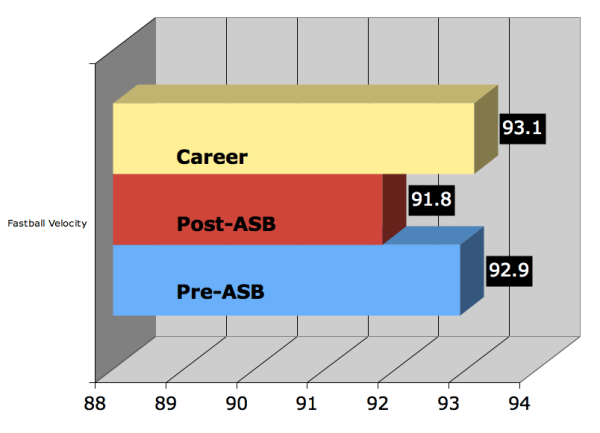
2. Fastball velocity is down – I took a look at McDonald’s fastballs (both his four-seam fastball and two-seam sinker) and found a noticeable drop in average velocity. His fastball offerings are down a full mile per hour since the All-Star Break. Keep in mind that McDonald’s 171-inning season in 2011 was the first time he had ever pitched more than 72 innings in a Major League season. Now he is at 141 innings this year and counting, so this McDonald that averages 92 mph on fastballs will likely remain for the rest of the year.

3. Opponents are getting their bats on his fastball – With McDonald’s drop in fastball velocity, hitters have found it much easier to put the pitch into play.

4. His slider has not been as effective – McDonald used the slider as a knockout in the first half, relying on it especially against right-handed hitters. Since then, it has still been a good pitch, but it is more hittable and not the dominant offering it had been. Perhaps the drop in velocity is a factor?

5. Many long innings – People often measure a pitcher’s stress level in a game by pitch count, and their stress level over a season by innings count. Hell, I just did the latter a couple paragraphs ago! But it is also good to see if he is throwing a lot of high-stress innings, which I measure as innings with 25 pitches or more. Given McDonald’s troubles, he has a lot more of these innings that take a lot of pitches to finish. Before the break, he averaged 15.3 pitchers per inning. Since then, he has averaged 19.3 per inning.

Okay, so all of those charts identify the particular problems McDonald has struggled with over the last month or so. But there are reasons to think that he might improve. In fact, there are some very good reasons to think that McDonald will pitch better over the last several starts of his season (assuming he stays in the rotation).

1. He is still making hitters swing and miss — especially with his curve – One of the main elements of McDonald’s game has been generating whiffs. His stuff is dominant at times, especially when he has his fastball-slider combination working. But since the All-Star break, McDonald has mixed in his curveball more often — and for good reason. Since the break, his curve has gotten hitters to flail almost as well as his slider does. Keep the curves coming.

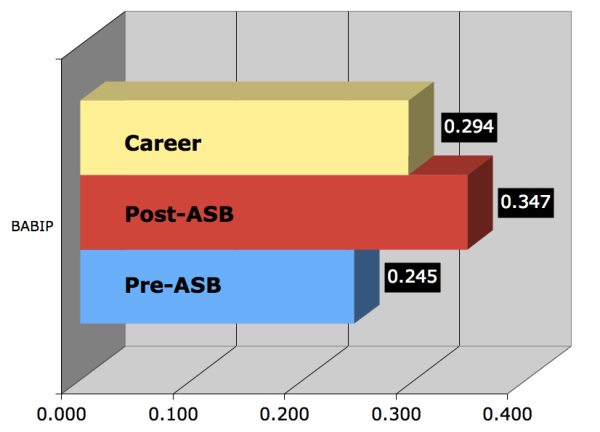
2. Bad BABIP luck – If you’re not familiar with BABIP, it stands for batting average on balls in play. Many sabermetricians say that unless a pitcher generates a lot of groundballs or a lot of line drive, fluctuations in BABIP are largely due to luck. Specifically, if a pitcher’s season BABIP is lower than his career BABIP, that’s good luck. If it is higher, that is bad luck.

McDonald has been unlucky since the All-Star Break. One big reason this should improve is the Pirates’ quality defense, which has the 3rd-highest rate of balls in play converted to outs in all of baseball.

3. Bad home run luck – Another sabermetrics theory on balls in play: pitchers mostly control giving up fly balls, less so for home runs. So in practice, if his season home-run-to-fly-ball rate is higher than his career rate: bad luck. If it is lower than his career rate: good luck. You can see that, like BABIP, McDonald’s luck has been a tale of two halves.

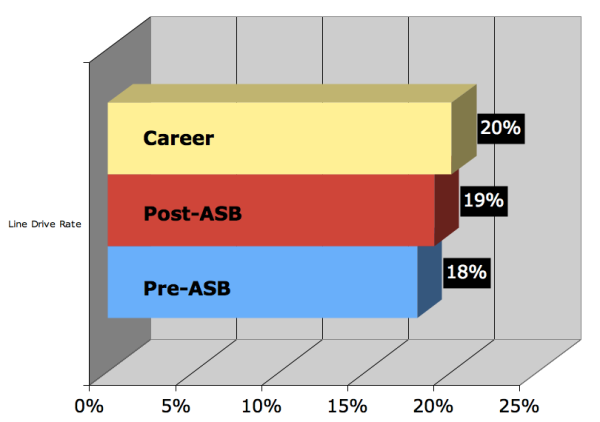
4. His line drive rate has held steady – Despite McDonald’s fastball and slider being put into play more often, opposing have not exactly smacked him around. This falls in line with our feelings that his recent BABIP is simply bad luck. A pitcher should not have that high of a BABIP unless there are a lot of liners being allowed.

So there you have it. The bad and the good of James McDonald. The referendum on whether he will stay in the rotation could come Thursday in his next start, though it would be wise to be patient and see if his luck turns.

Off To The London Olympics, And The Power Of The Moment

(Photo by Tom Nguyen/Creative Commons)

She got drunk and kissed me by the window as Saturday faded into Sunday.

I didn’t see it coming. That’s one aspect about our longest-lasting memories. Most of them occurred in an instant, unexpected. The head-on collision. The sudden diagnosis. But also the home run. The acceptance letter. The first kiss.

This is not a story about one of those kinds of memories. For this, I have been preparing for many months. And it is not one brief moment, but an overload of incredible experiences spanning many days.

I am going to the Olympics.

When I have talked with people about this, about 90 percent of the conversations have gone like this:

Person: “I heard you are going to the Olympics.”

Me: “Yeah, I am going to be a runner for Sheinhardt Wig Company NBC.”

Person: “Wow, how exciting!”

Me: “Yeah, I’m pumped. Should be great.”

Person: “Can you fit me into your suitcase?”

And then depending on the size of the person, I would joke about their ability to actually fit in my luggage. But the fact is, I have had probably one hundred of these conversations and I was lying. I am neither pumped, nor excited, nor do I think it would be great.

Instead, I am thrilled beyond belief. And it will be the opportunity of a lifetime. “Excited” and “great” don’t even begin the description.

I have been in love with the Olympic Games and their NBC broadcasts from a young age. I have specific memories of obsessively playing the Sydney 2000 video game. I was astounded by the Opening Ceremonies in Salt Lake City, the last American Games. I parked myself in front of the TV for so many hours of Beijing events, I think I left a dent in the sofa. And how can some of these sequences not stir one’s soul?

I always dreamed of being able to go to the Olympics, so much so that I even worked to try to get them to Pittsburgh. (And hey, maybe some day my crazy plan of a Pittsburgh Olympics will come to fruition. As long as the mascot is better than Steely McBeam.)

Then I saw an email in February 2011 with the subject line, “NBC Is Looking for 2012 OLYMPIC INTERNS.” I practically jumped out of my chair. This was my new No. 1 goal. A month after I mailed in my application, I was told I got an interview. Then a few months after that stressful conversation, I was told NBC accepted me. Joy! Then a few months later I found out I would be going to London (others will head to New York). Ecstasy! I have never been there before. Sometimes so many blessings work in your favor that it is almost unbelievable. I am very grateful for this chance.

So here I am. The bags are packed, with plenty of warm clothes because it is England. My phone has been put on the international plan. I renewed my MLB.tv subscription, because the Pirates will still be on at Midnight most nights.

Starting Saturday, I will be working long day after long day at the International Broadcast Centre. I have no idea what I will be doing there. I could be running tapes between rooms. I could be getting food orders.

(Photo by Graham Hogg/Creative Commons)

Fact is, I don’t care what I’ll be doing. I could be a glorified coffee cart the entire time and it does not matter to me.

I am going to wake up every day and roll out of bed into the Olympic city. The torch will be lit. The atmosphere will be like a 17-day party, with an energy that cannot be matched anywhere else on Earth. And I get to be a part of the most-watched broadcast in America. Even people who don’t like sports will check in, even if it’s just for the ceremonies.

If you don’t like the Olympic Games, I feel kind of sorry for you. Even I don’t get hyped up about rhythmic gymnastics, but what could be more exciting than the Olympics? There will be 302 medal events, and for their particular sports, they are like 302 world championships bookended by unmatched pomp and pageantry. For gymnasts, every single muscle move can mean the difference between a medal or an empty hand. For swimmers, every stroke becomes magnified. For track sprinters, a split-second hesitation can ruin the race of their lives.

In every case, all 10,000 men and women represent the most talented, most refined in the world at their sport. They run the fastest, jump the highest, represent the strongest. Their movements write the stories that captivate a planet for two straight weeks. And each individual has been working for not only four years, but for their entire lives, in preparation of their Olympic moment. It is the ultimate athletic event. It is the ultimate human drama. The only thing it is not: boring.

But for the athletes, their moment may be fleeting. They may only appear on the world’s stage for a day, or even just ten seconds.

I don’t get one moment. I don’t get one day. I get almost an entire month to live out my lifelong goal of being at the Olympics, and on top of that, my lifelong goal of working on a national sports broadcast.

This is not a first-kiss moment, wonderful but fleeting. This will be a lifetime of unforgettable moments, packed into four weeks. This is the Olympics, and I will be there.

And when they extinguish the flame, the memories I have carved will remain forever.

[Addendum: Due to the rules of the powers that be, I will not be using Twitter, Facebook or this blog to post updates about the Olympics. I will, however, still be on Twitter and following the Pirates as much as possible. And of course, I will be keeping a journal (online or otherwise) of my journey through London over the next month, to share with you all when I return in mid-August. Enjoy the Games!]

The Pirates Should Not Trade For Justin Upton

Upton may not be the superstar he seems to be, if he leaves Arizona. (Congvo/Creative Commons)

When I saw the news that the Pirates have engaged in discussions for Arizona’s Justin Upton, I was excited as anybody. This was Justin Upton, the 24-year-old phenom that blasts towering home runs and finished 4th in MVP races. I imagined Upton as a superstar cleanup hitter behind Andrew McCutchen as they led Pittsburgh from ignominy to a pennant.

But not everything is as it seems. When looking at a trade rumor, sometimes perception is not reality. Looking at the facts now, I don’t think the Pirates should trade for Justin Upton.

1. Upton’s offensive numbers are helped substantially by playing in Phoenix.

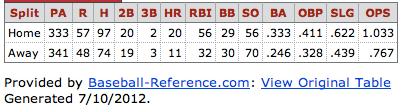
Two graphs demonstrate this pretty well. The first shows Upton’s 2011 numbers at Chase Field, and on the road:

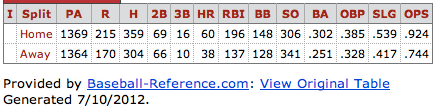
Oh. Well, that’s not really fair. I mean, that’s one season. Let’s take a larger sample size of Upton’s 660-game career:

Well then. Yes, Justin Upton hits the ball far. And many of those no-doubt home runs in Arizona you see on SportsCenter would be no-doubt home runs in Pittsburgh.

But Chase Field is a very hitter-friendly park, largely because the desert air allows the ball to travel further, especially when the retractable roof is open. The average player’s OPS is 28 points better at home. A 180-point difference is a major red flag to me regarding Upton.

And the dead-pull hitter Upton has become does not make him the best candidate to keep up his power numbers with PNC Park’s massive left field.

Here is a brief list of players that have posted a better road OPS than Upton over the last three seasons: Alex Gordon, Josh Willingham, Shin-Soo Choo, Alfonso Soriano, Marlon Byrd. Those are all good hitters, but hardly superstars.

2. Which Justin Upton would the Pirates get?

Last year, Upton was a bona fide MVP choice: a six-WAR player, a 30-homer hitter, owner of an .898 OPS and a terrific fielder and baserunner.

But this season is different. He only has seven homers at the break and a .755 OPS. Despite the fact that he has a higher BABIP (meaning more balls dropping in for hits), Upton’s batting average is down.

For my money, the biggest factor is that Upton is not hitting the ball as hard. Last season, he averaged 0.82 groundballs for every fly ball, and this season he is averaging 1.39 groundballs for every flyball. There is speculation that Upton has lingering shoulder problems. But whatever the reason, it’s obvious that Upton killing more worms with his grounders than he did last year.

3. His contract is significant to a small-market team.

Yes, Upton is cost-controlled. But that cost is a lot to a small-market club. (phxwebguy/Creative Commons)

When Upton is putting up MVP-like numbers as he did last year, money is almost no object. But if he continues his current groundball troubles, the contract becomes important. He is signed through 2015, and the last two years of the contract come up big. Upton will be owed $14.25 million in 2014, then $14.5 million in 2015.

That may be a drop in the bucket for the Yankees or the Rangers, but it is of utmost importance to the Pirates. Upton’s contract could take up more than 20 percent of the payroll, all for a player who seems to be a bit of an enigma.

Theoretically, the Pirates would be dumping a truckload of top prospects onto Kevin Towers’ yard, and then will have to get another truck full of Upton’s money for the rest of his contract. Instead of dealing away prospects for that scenario, the Pirates should use that money to try to make a splash on a free agent this offseason, or commit some cash for a Neil Walker or James McDonald extension. That way, the Pirates don’t have to give up…

4. The Diamondbacks will want far too much.

… Starling Marte, Jameson Taillon, Rudy Owens and Robbie Grossman. That’s who Tim Williams of Pirates Prospects thinks will have to be traded by the Pirates to get Upton. All are former or current Top 100 overall prospects, or in Owens’ case, a pitcher with a lot of value as a future rotation guy. These talented, cost-controlled young players are as good as gold for a small-market team looking to compete in these next few years. Arizona will likely ask for all of them, and they are in no hurry to deal Upton. If Towers doesn’t get overwhelmed by a trade offer, I think he would be just as happy to keep Upton around through 2015.

Instead of giving up the moon and the stars for one player, the Pirates should make a smaller splash: outfielders like Carlos Quentin, Shane Victorino, Josh Willingham or David DeJesus could make an impact on the 2012 Pirates team, and be had for much less.

Don’t commit to a player that derives most of his value from hitting in Arizona, a player that could prevent future free agency signings, a player who may not keep up his MVP status from last year. Justin Upton is a very good player, but there are far better trade options out there for Neal Huntington and the Pirates.

ANALYSIS: Five Reasons Erik Bedard Is So Underwhelming, And How To Fix It

Erik Bedard has stayed off the DL, but where is the dominance? (Keith Allison/Creative Commons)

Erik Bedard has been frustrating. There’s no other way to put it.

He was the Pirates’ Opening Day starter, and held true to that title through the month of April. In one span, he made hitters swing and miss so much that their whiffs created a tornado.

But now his season numbers in ERA and WHIP are now worse than Kevin Correia. What happened to the dominant Bedard we saw in April? Where is the pitcher that everyone said would be good as long as he stays off the disabled list?

Before we explore that, let’s look at his repertoire. Bedard is largely a three-pitch guy: four-seam fastballs, two-seam sinkers and curveballs have made up 85 percent of his pitches this year. He will also occasionally mix in a changeup to righties and a new cutter to lefties.

With that in mind, here are the five main factors for Bedard’s struggles, as I can tell. As always the data is from the indispensable Brooks Baseball.

1. His velocity is down.

This is not a huge surprise, since Bedard is now 33 years old and has been more banged up than Eric Lindros. But even from last year to this year, the average velocity on Bedard’s fastball has dropped from from 91.2 mph to 89.6 mph.

This leads to one major problem: the other team is hitting his fastball harder. Last year, 16.5 percent of Bedard’s four-seam fastballs put into play were line drives. This year, 26 percent of his fastballs put into play have been liners. It’s a small sample size, with only 46 fastballs being made playable this season, but 16.5% to 26% represents a huge jump.

The drop in fastball speed is likely making his changeup less effective as well. If your fastball is not a high-speed threat, that changeup becomes more hittable.

2. Bedard is not generating swinging strikes, especially since his minor injury in May.

A huge part of Erik Bedard’s game is getting opposing hitters to whiff. Between 2007 and 2009, he was one of the best pitchers in the American League at getting hitters to swing and miss. That ability has steadily decreased since that time.

He is not getting as many swings and misses on his fastballs and changeups, which hurts his overall game. Before Bedard suffered back spasms on May 9, he was getting opposing hitters to whiff on 9.2 percent of his pitches. Since then, only 6.9 percent of his offerings have made hitters swing and miss. That leads to a lower strikeout rate and a higher walk rate.

The back spasms are far from the only reason for Erik Bedard’s struggles. But you can’t deny that the injury has represented a pivot point for his results this year.

3. Righties are hitting him better than they ever have before.

For most of his time in the Majors, Bedard has been known as a left-hander without a discernible platoon split: righties have a .693 OPS against him over his career and lefties have a .681 OPS. Not much to see there.

This year has been different. Right-handed hitters own a .791 OPS (and 8 homers) against Bedard this season, compared to lefties hitting for a .656 OPS. Again, small sample size since Bedard has only faced left-handed hitters in 78 plate appearances.

But compared to 2011, Bedard is striking out far fewer righties and walking far more of them. That is beyond problematic; it is part and parcel to his troubles. He needs to work on his fastball command. Against righties this season, he is not throwing his four-seamer for strikes as often (38.4 percent ball rate vs. 35% ball rate last year).

4. His sinker has not been as effective.

It is a small qualm, but Bedard has not gotten great results from his two-seam sinker. The sinker is a big part of Bedard’s repertoire, especially against left-handed hitters.

The problem is that sinker has lost velocity just like the four-seamer, and it is not getting hitters to swing and miss. Instead, they are hitting it harder than ever:

The ground-ball rate is encouraging. But the fact that hitters are getting so many line drives off Bedard’s four-seam and two-seam fastballs (again, loss of velocity) means that Bedard has the 6th-highest line-drive rate among any National League pitcher. If hitters are knocking line drives off you, you are in trouble.

5. He needs to improve his pitching from the stretch.

For some reason, Bedard has a 2.8 strikeout-to-walk ratio with the bases empty this season, but a 1.3 strikeout-to-walk ratio with men on base. There’s nothing in his career before Pittsburgh to demonstrate any innate trouble with pitching from the stretch, so perhaps Bedard just needs more confidence attacking the zone with runners on.

So what’s the solution?
In Searage We Trust. (Keith Allison/Creative Commons)

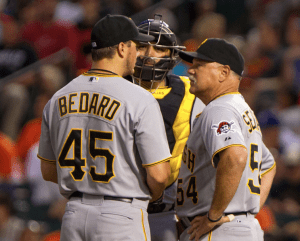
I’m not a pitching coach. But Ray Searage is, and he is a very good one. He has overseen the breakthroughs of Jeff Karstens and James McDonald, and the potential renaissance of A.J. Burnett and Brad Lincoln. I can only speak to what I have seen in Bedard’s starts and what the data tell me.

Don’t let Bedard start until July 20. That will give Bedard 13 days between Major League starts. That is one week to rest and one week to work on his command. When he returns on the 20th, that would give Bedard three starts before the MLB trade deadline. If the rest does Bedard and his back some good, he can earn his rotation spot for August. If he continues his downturn, there will be other pitchers available to take his spot.

(Note: It looks like manager Clint Hurdle will give Bedard 10 days of rest between starts to “give him time to tweak,” per Kristy Robinson. That sounds pretty good.)

—  Have him throw more curveballs (especially for first pitch). Bedard seems to work off his fastball and changeup for his first pitch. But Bedard’s curveball is probably his one true “plus” pitch, and he can command it for strikes a decent two-thirds of the time. At this point of his struggles, everything is up for debate, even the pitches that Bedard works off to start at-bats.

Work on fastball command. If the velocity is down on Bedard’s fastball, so be it. Aging is a bitch. But Bedard is walking 10 percent of hitters this year, which is among the highest rates in the NL. On Friday night, Bedard walked Buster Posey on four straight fastballs. That’s unacceptable. If he can’t consistently put his fourseam fastball in the zone, Erik Bedard won’t be long for this baseball world. Use Bedard’s period between starts to work on getting that fastball on top of the plate.

But look back before that four-pitch walk to Posey on Friday night. The first time through the Giants order, Bedard through three no-hit innings with only one walk. That’s what he can do: generate flyballs and groundballs and get hitters to whiff and give the Pirates a chance to win.

To go back to the old sabermetric standby, Erik Bedard’s second-half ERA will probably be closer to 4.19 (his current xFIP) than his first-half 4.80 ERA. That is a decent jump, but it won’t happen just because the numbers say they should. Bedard has a lot to work on.

The Pirates have already received enough good starts from Bedard to make him worth the one-year, $4.5 million contract. But if he can look more like the pitcher fans saw in Baltimore and Seattle, he could be worth so much more. He could even be on the PNC Park mound as the Bucs wrap up a pennant.

The FOX “National” Broadcast Will Lower Viewership For Pirates-Royals

There is occasionally talk about the FOX Saturday Baseball broadcasts being the “big stage” for baseball teams. Often, that’s true. If there is one huge national game on FOX, or even splitting the nation to two or three games, the broadcast is available to more people than just the regional cable broadcasts.

But for Saturday’s Pirates-Royals game, being on the FOX broadcast actually reduces the broadcast territory.

First, let’s look at the Pirates broadcast map for games aired on the ROOT Sports cable channel.

The important point here is that Pirates games on ROOT Sports are available throughout much of Pennsylvania and West Virginia. So what territory will be able to watch Saturday night’s Pirates-Royals game on FOX?

Click on image for bigger map at The 506.

While the FOX broadcast gains a little larger chunk of Ohio, much of West Virginia (and Erie, Pa. area) is lost to Indians-Cardinals and most of eastern Pennsylvania instead gets Mets-Yankees. That has to be a net loss of viewership area for Pirates fans.

What about for Royals fans in the Midwest? The team’s website says most games are “available in Kansas City, Kansas, western and central Missouri, Nebraska, Iowa, Arkansas and Oklahoma.” That is a healthy dose of area. So how much of that will get to see Saturday night’s game?

Again, click on the map for a larger version at The 506.

Most of Kansas gets to keep the Royals broadcast, as does a good bit of Nebraska. But it seems like a lot of Missouri is lost, and forget about Arkansas, Oklahoma and Iowa.

So it seems to my eye that being one of the FOX “national” games drastically reduces the number of people who can watch Saturday’s Pirates-Royals game. No one outside of those pictures above will be able to watch the game. And we haven’t even touched the fact that people who normally watch Pirates or Royals games on MLB.tv are plum out of luck.

There is a rumor, I don’t know how much truth there is to it, that the Pirates could have moved the game back to  4:10 pm ET to air on the regular cable channels. But pushing back the game three hours would inconvenience the sellout crowd who bought tickets to the game/Boys II Men postgame concert. So 7:15 ET on FOX it shall be, no matter how much the FOX broadcast map limits viewership.

MLB and FOX, frustrating baseball fans together since 1996.